It Ain't AGI Until H100s Go for $30 an Hour
October 14, 2026
Kyle Corbitt with Claude Opus
Sparks of AGI
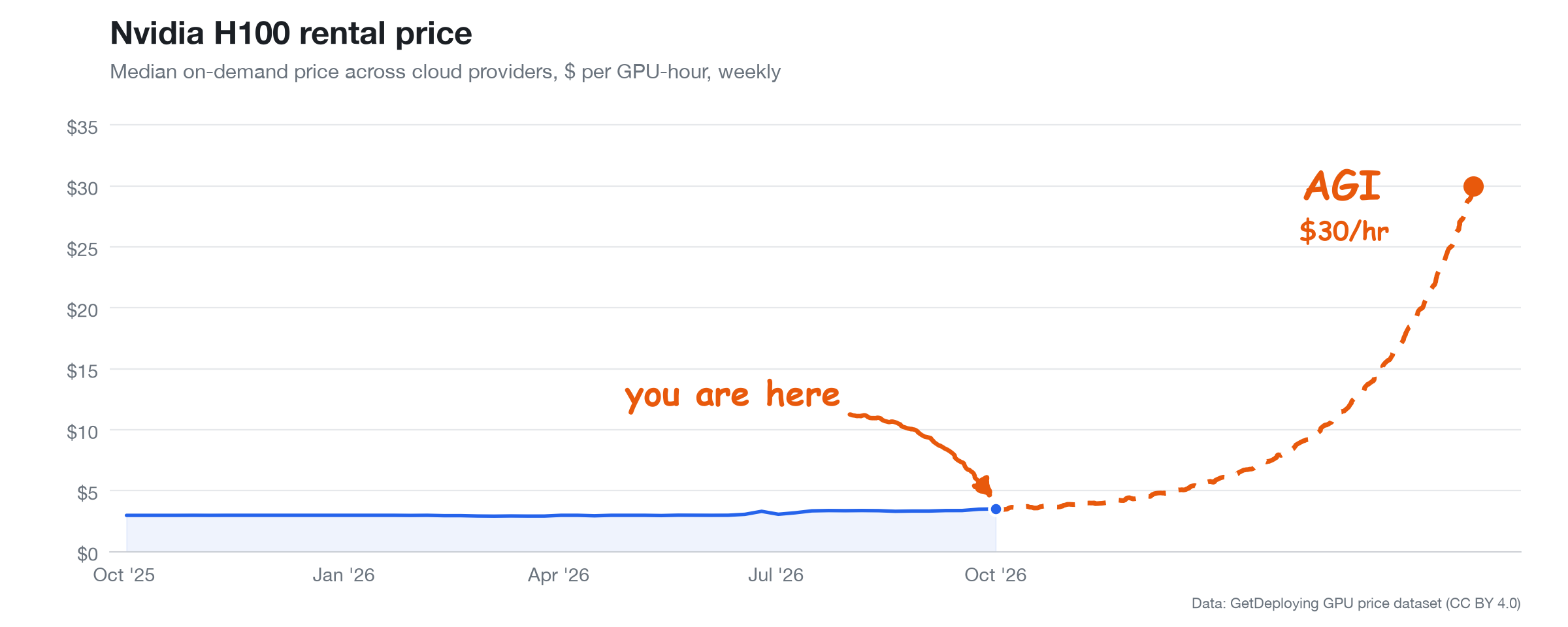
Greg Brockman claimed that GPT-6 Astra marks the start of the “AGI era.” We may be in the AGI era, but if AGI means an agent that can “outperform humans at most economically valuable work” it isn’t here yet. You’ll know it is when the price of AI compute jumps 10x from where it is now.
Tokenomics with AGI Characteristics
In October 2026 you can rent an H100 for about $3.57 an hour. That’s expensive; it’s up 19% over the past year. But it’s nothing compared to where prices are going as we start deploying real AGI.
An AI agent that can actually replace knowledge workers will be competing directly for the white-collar jobs of tens of millions of highly paid professionals. That’s a liquid market with a well understood clearing price.
Let’s do some basic math. By AI 2040’s estimates, there’s enough compute today to run AGI agents that could replace about 95 million full-time workers.1 The top 95 million earners in the world make at least $35 an hour.2 So an AGI that can really do one of these jobs must be worth at least $35 an hour. (Many white-collar jobs in today’s economy pay far more. That’s just the floor price!)
How much compute will one of these agents use? The most capable publicly available model today is Claude Opus 5.5, which tops the Artificial Analysis Intelligence Index. Run as a full-time agent, it costs about $8.21 an hour at unsubsidized API prices.3 The cost of reaching a given level of capability has been falling 5–10x a year, and we’re already close to the AGI threshold. So it’s reasonable to assume an AGI-complete agent will run on a hardware footprint no larger than Opus 5.5’s today.
Let’s assume Anthropic spends half of that $8.21 on compute.4 At $3.57 an hour, that’s 1.15 H100-hours for each hour of agent time, so one H100 can run about 0.87 agents.5
If these agents can truly replace a white-collar worker, but supply is still limited by the amount of compute running in the world, something has to give. We already know demand for these workers is high: at least $35 an hour. With supply fixed, either (a) compute gets rationed (frontier labs stop selling externally entirely), or (b) prices rise until supply and demand balance.
Where do they balance? On the conservative assumptions above, at about $30 per H100-hour: 0.87 agents at $35 an hour. If we make less conservative assumptions, such as that Anthropic’s API margins are well above 50%, that AGI can run on the same hardware as a cheaper model like GPT-6.1 Sol instead of Opus 5.5, or that employers will pay what a worker actually costs them including benefits, you can make a compelling case that prices will rise as high as $75 per H100-hour.6
GPU prices probably won’t be the weirdest thing we see on the way to AGI. But they may be one of the easiest to monitor and trade on.
Footnotes
-
Workers the compute could replace. AI 2040 estimates about 20M H100-equivalents of AI compute at the start of 2026, growing about 3.3x a year (AI 2040). That’s roughly 50M by October. Big AI companies spend roughly half their compute on R&D (AI 2040), leaving about 25M to serve customers. At 0.87 agents per H100, running around the clock (8,760 hours a year, against 2,000 for a full-time worker), that’s about 95M full-time workers. ↩
-
The wage floor. US figures are measured: among people who worked at least 40 weeks in 2023, 27.9M earned $100,000 or more (about $50 an hour) and 75.8M earned $50,000 or more (about $25 an hour) (DQYDJ, from Census CPS data). I couldn’t find a global count. I estimate another 20–40M people outside the US earn $50 an hour or more, and assume the same shape below that. That puts the 95-millionth highest-paid worker at about $31–40 an hour. All earners stand in for white-collar workers here. ↩
-
Cost per agent-hour. I assume an agent reads 1,000 input tokens and writes 80 output tokens a second, with 90% of input served from cache: 288,000 output and 3.6M input tokens an hour. At Opus 5.5 list prices ($20 per million output tokens, $0.20 cache reads, $5 cache writes), that’s $5.76 + $0.65 + $1.80 = $8.21. ↩
-
Margins. This is a wildly conservative assumption. SemiAnalysis estimates Anthropic’s API gross margin is above 80%, and its margin across the whole business is in the mid-60s even including heavily subsidized subscription plans (Crypto Briefing, KuCoin, relaying the WSJ). Higher margins make each H100 more valuable. At 80% margins one H100 runs 2.2 agents. The fleet then covers about 240M workers, reaching down to a wage floor near $19 an hour, and an H100-hour is worth about $42. ↩
-
“H100” is just a convenient price unit. It means compute that rents for $3.57 an hour today. Anthropic serves on TPUs, Trainium and newer Nvidia chips. A literal H100 may rise less than the newest chips. ↩
-
The less conservative case. More agents per H100 means the fleet replaces more workers and reaches further down the wage ladder, so I lower the floor using the distribution in note 2. GPT-6.1 Sol ($2 per million input tokens, $0.10 cached, $10 output) costs $3.92 per agent-hour. At a 50% compute share that’s 1.8 agents per H100, a fleet of about 200M workers and a floor near $22 an hour. Employers’ full cost is about 1.43 times wages, since wages and salaries are 70% of private-industry compensation costs (BLS). Counting full employer cost, Opus at 80% margins gives about $60 per H100-hour, Sol at 50% about $57, and Sol at 80% about $75. ↩